
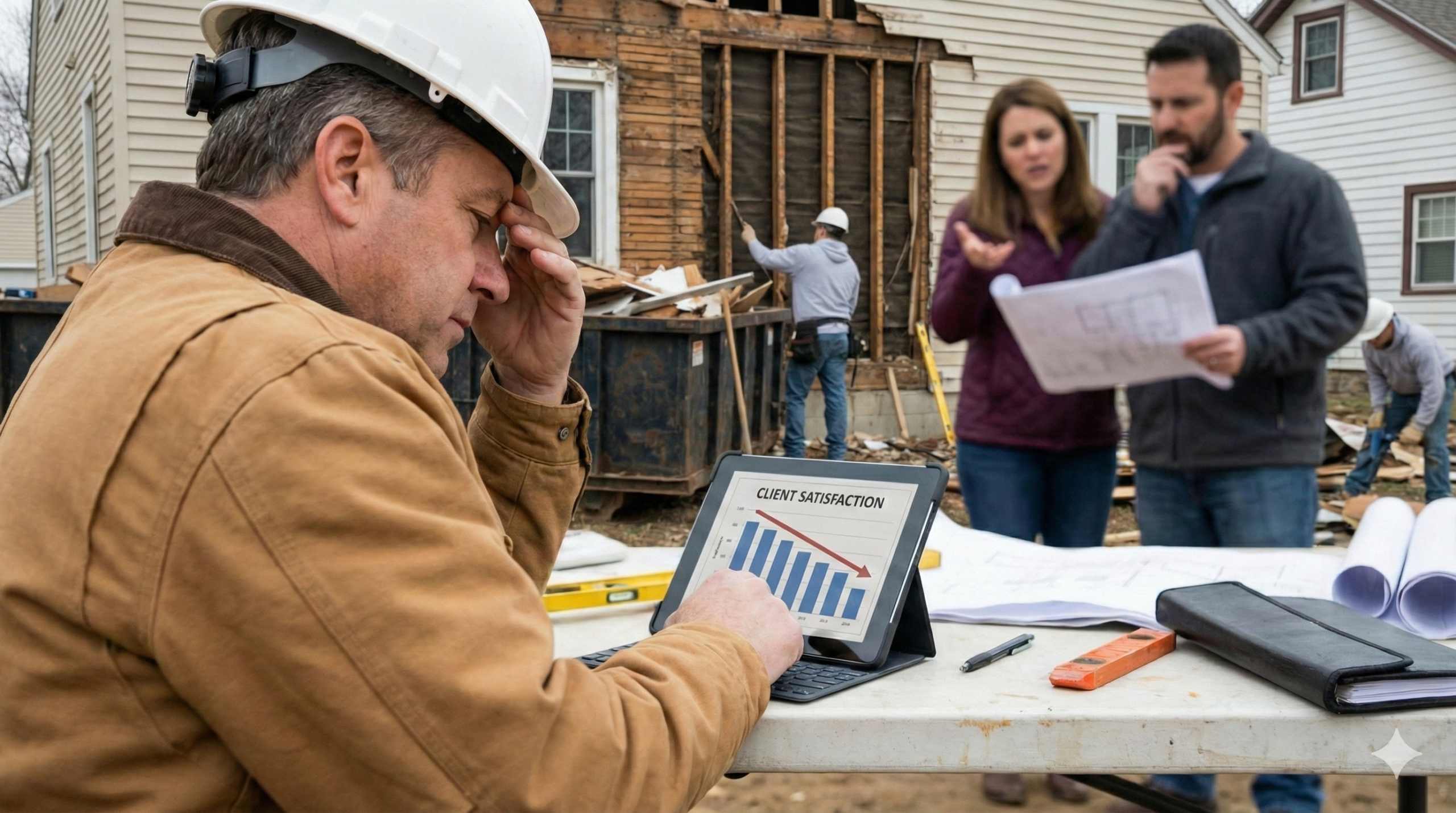
The “Good Builder” Trap
You can build the most beautiful custom home in the county. You can frame perfectly, install trim with surgical precision, and bring a project in on budget. But if the homeowner felt ignored, anxious, or blindsided during the process, you have failed.
This is the “Good Builder” trap. Most Builders, Contractors, and trades believe that the product (the house) is all that matters.
But in today’s market, the process matters just as much.
If your phone is blowing up with angry texts at 9 PM, if you are fighting tooth and nail for final payments, or if your referrals are drying up, it is rarely because of your craftsmanship. It is because of your Client Experience (CX).
In this blog, we aren’t going to talk about “being nicer.” We are going to break down a tactical, business-focused system to control expectations, empower your team, and turn stressful projects into 5-star reviews.
What is “Client Experience” (and Why Should You Care?)
In the tech world, they call it UX (User Experience). In construction, we usually just call it “customer service,” but that term is too soft.
Client Experience (CX) is simply the gap between what the client expects and what actually happens.
- Bad Experience: They expect a clean site; they find cigarette butts. They expect a finish date of Friday; you finish on Tuesday without telling them.
- Good Experience: They expect a mess; they find a zipped up work zone. They expect a delay; you warned them about it two weeks ago.
When you master CX, you stop being a commodity and start being a premium brand. You can charge more, you get paid faster, and your clients become your best sales team.
Phase 1: Solving Communication Breakdowns
A frequent complaint in the construction industry is consistent: “My contractor never calls me back.”
Most owners try to solve this by answering the phone 24/7. This leads to burnout. The solution isn’t to communicate more; it’s to communicate proactively.
The “Friday Update” Protocol
Clients text you late at night because they are anxious. They don’t know when they will hear from you next, so they chase you.
You can eliminate 80% of these interruptions by implementing a strict Friday Update system. If you’re not using an online platform like Co-construct, Buildern, or TallyPrime, you can implement this approach. Every Friday by 2:00 PM, send an email or a short video to active clients covering three things:
- What happened this week: “We finished the rough electrical and plumbing.” (Include photos).
- What is happening next week: “Drywall delivery is Monday; expect noise and dust on Tuesday.”
- What we need from you: “Please finalize the tile selection by Wednesday.”
When a client knows the update is coming, they stop chasing you. You create a “silence buffer” that protects your sanity.
The “Rules of Engagement” Meeting
Before a hammer swings, you must set boundaries. During your onboarding, hand over a “Client Experience Manual” that answers the manageable and predictable questions before they become problems:
- Working Hours: “Ensure clients are aware you do not answer text messages after 6 PM or on Sundays.”
- Chain of Command: “Please direct all scope questions to the Project Manager, rather than the trades.”
- Site Rules: Be clear about bathroom usage, parking, and pet safety.
Phase 2: Guard Against “The Dip”
Every construction project, no matter how well planned, follows an emotional curve.
- The Start: High excitement (“We love our new kitchen ideas!”).
- The Middle (The Dip): The “Trough of Sorrow.” The house is a mess, the walls are open, money is flying out of their account, and progress looks slow.
- The End: Recovery and joy.
The mistake some contractors make is pretending “The Dip” won’t happen.
Instead, show your clients a chart of this emotional roller coaster on Day 1. Advise them: “Ms. Client, right now you are excited. In six weeks, when there is drywall dust in your coffee, and we are waiting on a window delivery, you are going to be frustrated. That is normal. My job is to guide you through that dip.”
When the stress hits later, they won’t panic and blame you. They will remember you predicted it, which builds massive trust.
Phase 3: Mastering the Hard Conversations
Conflict is inevitable. Materials get delayed. Prices go up. How you handle bad news defines your client satisfaction.
The “Bad News Sandwich”
Never hide a delay, hoping you can make up the time. It always backfires. When you have bad news, deliver it immediately using this framework:
- The Bread (Direct Facts): “The custom vanity is backordered by three weeks.”
- The Meat (Honest Impact): “This means we cannot install the sinks until the 15th, pushing the finish date back.”
- The Bread (Empowerment/Solution): “We can wait for it, OR I found a similar unit in stock at [Vendor] that keeps us on schedule. Which option do you prefer?”
By giving them a choice, you stop being the villain and start being the advisor.
Stopping Scope Creep
“While you’re here, can you just fix this door?”
This sentence kills profit margins. To stop it, implement a “Zero Verbal Orders” rule. Empower your crew to say: “I’d love to help with that! Let me contact the office to get a Change Order drafted so we can get it approved and scheduled.”
This creates a formalized friction point that ensures you get paid for every minute of extra work.
Phase 4: Team Empowerment and Job Site Etiquette
Your team empowerment strategy is directly linked to your client experience. Your crew is the face of your brand. If they are late, messy, rude, or loud, your 5 star review disappears.
You must train your trades on the “Livable On Site” standards:
- The Last 15 Minutes: The workday ends 15 minutes early, strictly for cleanup. No tools are left out, ever!
- The Morning Hello: If the client is home, the lead trade must smile, say good morning, and explain the goal for the day.
- Respect the Space: No loud radios, no smoking in the home or yard, and zippers on all dust walls.
When your team takes pride in the environment as well as the build, the client feels respected.
Phase 5: How to Get the 5 Star Review
Don’t wait until you send the final invoice to ask for a review. That is when the client feels the “pain of paying.”
The psychological sweet spot to ask for a review is immediately after the Final Walkthrough. They are standing in their beautiful new space, glowing with happiness.
The Tactic: Do not email a link later. Text them the link while you are still in the driveway, or better yet, when you’re standing beside them discussing it.
“Hey [Name], I really enjoyed working with you on [project]. Would you mind tapping this link, dropping a quick rating while I load up the truck? It would be appreciated and help others looking to have a similar experience.
Final Thoughts
Improving your client experience isn’t about buying expensive closing gifts or bending over backward to please irrational demands.
It is about predictability.
When you control the communication, educate the client on the emotional journey, and empower your team to respect the home, you remove the anxiety from construction. That is how you stop the angry phone calls and start building a backlog of referral business.
Ready to Fix Your Business?
If you are tired of being the “firefighter” in your business, handling angry clients, chasing payments, and managing chaos, it’s time for a change.
I help construction owners build these systems so they run smoothly.
Book a Business Freedom Audit Call with me today
https://calendly.com/cohesionservices/businessfreedomanalysis